

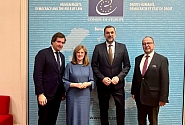
On Tuesday, 9 September, in Paris, Deputy Speaker of the Latvian Parliament and Chair of the Monitoring Committee of the Parliamentary Assembly of the Council of Europe (PACE), Zanda Kalniņa-Lukaševica, presided over a meeting of the Committee focusing on recent developments in Bosnia and Herzegovina, Georgia, and Spain. The Committee also considered an assessment report on the functioning of democratic institutions and the rule of law in Hungary, expressing concern over the shrinking space for independent media and civil society.
“When democratic institutions are deliberately weakened and civil society is pushed aside, this is not solely a challenge for the country concerned but a threat to Europe as a whole. The responsibility of democratic states is to assist partners in safeguarding the fundamental values of democracy and to ensure they are not instrumentalised against democracy itself. We are confronted daily with such challenges, whether through cyber and hybrid attacks, disinformation, economic pressure, or corruption. By looking at the full picture, we can strengthen our collective resilience through critical thinking, judiciary, and free media,” underlined Z. Kalniņa-Lukaševica.
The Monitoring Committee exchanged views with the Minister of Foreign Affairs of Bosnia and Herzegovina, Elmedin Konaković, focusing on the internal political situation and on strengthening democratic institutions and resilience.
In a discussion with representatives of the Georgian non-governmental organizations “Human Rights House Foundation” and “Transparency International Georgia,” the overall situation in Georgia was reviewed, with particular attention given to the challenges faced by these NGOs.
"The newly introduced so-called ‘transparency regulation’ in Georgia poses serious risks to democratic processes and threatens the ability of non-governmental organisations to operate freely. It is therefore essential that the international community continues to support Georgia’s independent civil society and enhance its capacity to defend our shared democratic values,” stressed Ms. Kalniņa-Lukaševica.
The Monitoring Committee further reviewed Spain’s progress in implementing the recommendations of the Group of States against Corruption (GRECO), notably concerning the parliament, judiciary, government, and law enforcement bodies. Ms. Kalniņa-Lukaševica emphasised that fight against corruption and strengthening of public trust are of vital importance to all member states of the Council of Europe and that no derogations from democratic standards can be accepted.
The Committee also adopted its report on Hungary, which concludes that in recent years the country has experienced democratic backsliding and a weakening of the rule of law, including concentration of power, reduced judicial independence and anti-corruption capacity, and restrictions on media freedom and civil society. The report, published today, will be debated at the Assembly’s plenary session later this month, informs Z.Kalniņa-Lukaševica.
The Monitoring Committee is tasked with verifying member states’ compliance with obligations under the Statute of the Council of Europe, the European Convention on Human Rights, and other relevant treaties, as well as commitments undertaken upon accession to the Council of Europe. Z. Kalniņa-Lukaševica has been chairing the Committee since 6 March 2024.
Saeima Press Service