



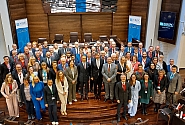
On Tuesday, August 26, parliamentarians from the Baltic Sea region agreed on strategic directions for addressing security, climate, and democracy challenges. During the conference, they also discussed geopolitical challenges, energy security, protection of critical infrastructure, youth engagement, environmental protection, and sustainability.
“We agreed to strengthen security of the Baltic Sea region, with special attention to hybrid threats, acts of sabotage against underwater infrastructure, the operations of Russia’s ‘shadow fleet,’ and the risks posed by uninsured tankers, as well as NATO and European Union coordination on maritime security,” emphasized Baltic Assembly (BA) President and head of the Latvian delegation Jānis Vucāns. He noted that the delegates called for creation of a permanent Baltic Sea security mission. To protect critical infrastructure, the adopted document highlights the need for a unified legal framework for underwater infrastructure protection and establishment of a rapid response mechanism.
On the topic of energy security, parliamentarians focused on reducing dependence on fossil fuels, resilience of regional energy systems, protecting critical infrastructure, as well as modernization of energy networks, and ensuring a fair energy transition. The head of the Baltic Sea Parliamentary Conference (BSPC) Working Group on Energy Security, Self-sustainability, Resilience, and Connectivity, Andris Kulbergs, noted that the parliamentarians had concluded two years of work and prepared practical recommendations to enhance regional energy security.
“Our working group has taken a decisive step to strengthen the region’s energy security and self-sustainability. Over two years, we not only developed theoretical solutions but also visited strategically important facilities, gaining direct insight on the key challenges,” said Kulbergs during the session on energy resilience and infrastructure protection in the Baltic Sea region. He stressed that the group’s findings were unanimous: “The Baltic Sea region is a primary target for hybrid threats, and Russia’s aggression against Ukraine serves as a harsh but valuable lesson.”
A.Kulbergs underlined that the work does not end here. It is now up to each of us to turn these recommendations into reality. The insights we’ve gained must be transformed into concrete actions that shape policies and drive real change. The working group invites all stakeholders – governments, parliaments, and civil society – to study the prepared materials and take part in their implementation.”
The working group addressed issues such as strengthening regional energy systems and expanding renewable energy capacities, protecting critical infrastructure from hybrid attacks, maritime safety and coordinating naval cooperation, improving mobility and logistics for both civilian and military needs, and advancing digital infrastructure and cybersecurity capabilities.
At the end of the BSPC, it was decided to establish a working group on cybersecurity and information resilience, which will operate for two years and present its first report next year at the 35th Baltic Sea Parliamentary Conference.
In their resolution, the parliamentarians also expressed strong support for the people of Greenland and their inalienable right to decide on their own state and future, which is a fundamental principle of international law that must not be violated, J.Vucāns emphasized. The conference also reaffirmed unwavering support for Ukraine’s sovereignty and territorial integrity, as well as for Ukraine’s path to membership in the European Union.
Environmental protection and sustainability were also key topics, including plans for restoring fish stocks, developing green shipping corridors, and digitizing marine protected areas.
The 34th Baltic Sea Parliamentary Conference is being held this week in Mariehamn, Åland Islands, with a focus on the Baltic Sea as “our lifeline” emphasizing cooperation, security, and sustainability. Parliamentarians are discussing a broad range of topics, including, the role of youth in Baltic Sea cooperation, shared responsibility for a sustainable Baltic Sea under the European Ocean Pact, energy security and infrastructure protection in the region, and geopolitical challenges to ensuring democracy and stability in the Baltic Sea region.
The conference was attended by Deputy Speaker of the Saeima Antoņina Ņenaševa, BA President and head of the Latvian delegation Jānis Vucāns, chair of the BSPC Working Group on Energy Security, Self-sustainability, Resilience, and Connectivity Andris Kulbergs, and chair of Saeima Economic Committee Kaspars Briškens.
About BSPC
BSPC is a regional parliamentary forum founded in 1991 at Finland’s initiative to foster a shared identity in the Baltic Sea region through closer cooperation among the region’s countries and municipalities. Its members include national and regional parliaments of the Baltic Sea states, as well as the Baltic Assembly, the European Parliament, and the Nordic Council.
Photos:https://www.flickr.com/photos/saeima/albums/72177720328580311/
Disclaimer & copyright: https://saeima.lv/lv/autortiesibas
Saeima Press Service