


 Gallery
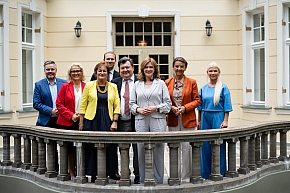
On Friday, 22 August, heads of the Nordic and Baltic delegations to the Parliamentary Assembly of the Council of Europe—MPs from Latvia, Lithuania, Estonia, Finland, Sweden, Norway, Denmark, and Iceland—held a meeting and signed a joint declaration affirming their unwavering commitment to ensuring peace, security, and democracy in Europe.
Zanda Kalniņa-Lukaševica, Deputy Speaker of the Saeima and Head of the Latvian delegation to the Parliamentary Assembly of the Council of Europe, stated: “Disinformation, deliberate division of society, the sowing of fear and distrust, inflows of foreign funding used in political campaigning, and other hybrid threats are increasingly evident in many parts of Europe, especially in countries bordering Russia. Therefore, we cannot afford to be naïve or unprepared, as the threats of foreign interference is also present in the Baltic and Nordic region.”
The main item on the agenda was the identification of threats to democracy and ways to respond to them at both national and European level. A dedicated working session was held on the situation in the Baltic Sea, hybrid threats, and the instrumentalization of migration.
Participants agreed that the Nordic and Baltic region is particularly vulnerable due to its location in Russia’s immediate neighbourhood and being part of the external border of the European Union and NATO—a place where different value systems clash.
The heads of delegations expressed readiness to strengthen societal resilience against various hybrid threats aimed at destabilizing communities and undermining trust in the democratic system. The need to defend independent media and civil society—essential preconditions for a viable and lasting democracy–was also emphasized.
In their joint declaration, MPs strongly condemned Russia’s aggression against Ukraine, including the deportation of children and other war crimes, stressing that support for Ukraine’s sovereignty and territorial integrity is not only a matter of solidarity but also a question of the security of European democracies.
“Today we demonstrated that the voices of the Nordic and Baltic states are united in defending democracy and security in our region and in Europe as a whole. It is our duty to strengthen societal resilience against foreign interference,” emphasized Zanda Kalniņa-Lukaševica, initiator of the meeting.
Parliamentarians firmly committed to continued cooperation in order to share experiences and develop effective measures, including legislative frameworks, to enhance preparedness and counter new threats—Russia’s attempts to divide societies, influence the work of parliaments and governments, as well as possible attempts to steal elections. The parliamentarians also decided on the need to strengthen cooperation in order to increase the influence of the NB8 group within the Parliamentary Assembly of the Council of Europe.
The meeting in Latvia continued the discussion initiated this April at the Parliamentary Assembly of the Council of Europe, when Zanda Kalniņa-Lukaševica’s report on the threats of foreign interference to democracies in Europe was adopted. The report approved by the Assembly includes several courses of action that states need to implement in order to prevent hostile countries from maliciously influencing democratic processes. These include, for example, updating national security concepts to include expanded definitions of security and new measures to address the growing threats of foreign interference operations.
In order to strengthen societal resilience against foreign attempts to sway elections, it is recommended to include media literacy in state education programs from an early age, thereby equipping pupils with essential skills to navigate today’s complex information environment.
Furthermore, to counter the risks posed by artificial intelligence technologies generating false information or manipulative content, states must implement measures that prevent the use of AI systems aiming to undermine the independence and effectiveness of democratic institutions, while ensuring the protection of democratic processes and safeguarding freedom of opinion and expression.
In addition, the report highlights the importance of effective management of conflicts of interest, lobbying, and political financing—member states are urged to review regulations concerning financial donations from foreign sources to political parties and election campaigns.
Given that foreign interference often transcends national borders, the fight against hybrid threats calls for strengthening cooperation at the international level, including by drawing on the experience and resources of existing international centres of excellence, such as the European Centre of Excellence for Countering Hybrid Threats, NATO Cooperative Cyber Defence Centre of Excellence, and NATO Strategic Communications Centre of Excellence.
Saeima Press Service